
AI SEO & AEO: Grounding Queries and Fan-Out: What Really Happens When Someone Asks an AI About Your Business
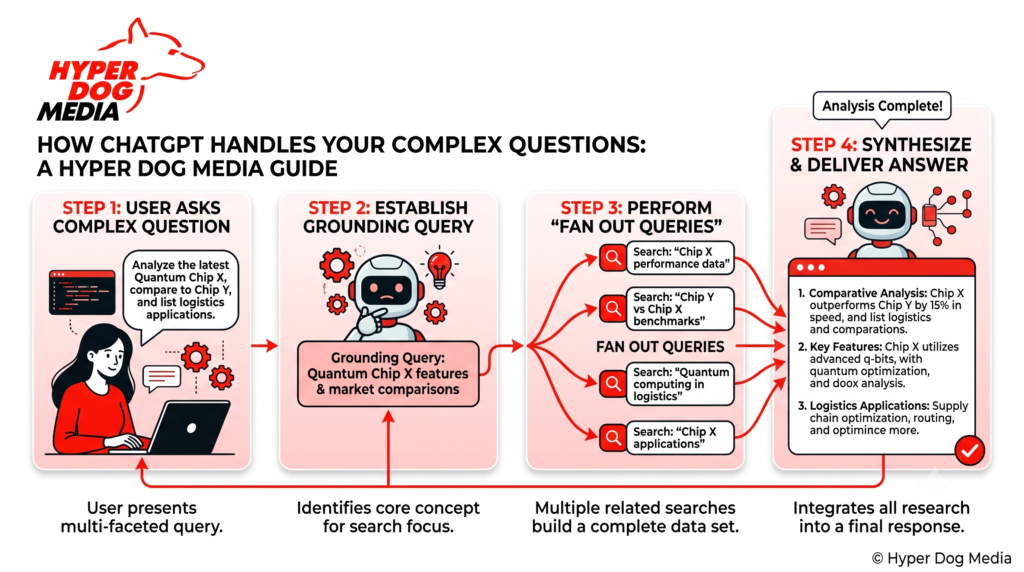
Most people picture AI search the way they picture Google: you type a question, the machine looks it up, you get an answer. One question in, one lookup, one answer out. That’s not what happens with AI search. When you ask ChatGPT, Gemini, Perplexity, or Copilot a real question, the model quietly turns your single prompt into a research project — often a dozen or more separate searches — before it writes a single word back to you. Two concepts explain the whole process: “grounding” and “query fan-out”. Understanding them changes how you think about content, because the query you’re optimizing for is almost certainly not the query the AI is actually running. Step 1: the model decides whether it needs to look anything up An LLM has a huge amount of knowledge baked into its training data. For a lot of questions, that’s enough — nobody needs a live web search to learn what a keyword is. But training data has a cutoff date, and it has gaps. So before answering, the model makes a judgment call: “am I confident enough to answer from my training data, or do I need outside evidence?” Queries about “latest,” “current,” or otherwise time-sensitive information tend to trigger web grounding, and some systems use an explicit confidence threshold — if the model’s internal knowledge scores below it, a search fires. When the model decides it needs evidence, it forms a “grounding query”: the search it runs to anchor its answer to something real and verifiable. Grounding is the process of connecting AI output to verifiable, real-world information, and it’s the primary defense against hallucination — plausible-sounding statements that happen to be false. That’s the “why.” The “how” is where it gets interesting for anyone producing content. Step 2: one question becomes many The model doesn’t run your question verbatim. It decomposes it. Query fan-out is a retrieval technique that breaks a single complex prompt into multiple distinct sub-queries. Rather than treating the input as one isolated search term, the AI expands the intent, generating a series of related questions to gather a complete picture, runs those searches in parallel, and combines what it finds into a single readable answer. Say someone asks: “Who’s the best search engine optimization company in Denver for a small business?” The model doesn’t search that string. It fans out into something closer to: – search engine optimization companies Denver – small business website cost Colorado – Denver search engine optimization agency reviews – WordPress vs Squarespace for small business – what to look for in a search engine optimization agency – Denver marketing agency pricing Six searches minimum. Often many more. Query fan-out takes one question and quietly explodes it into dozens — sometimes hundreds — of smaller questions. Step 3.: synthesis Once the sub-queries come back, the system pulls the top results from each into its context window and gets to work. It weighs the retrieved content against quality signals — experience, expertise, authoritativeness, trustworthiness — then reasons across the pieces, comparing facts and connecting them into a single coherent response. Good answers often go a step further and preemptively address the follow-up questions the user hadn’t asked yet. What comes out isn’t a list of links. It’s one answer, assembled from fragments of ten or twenty different pages, with a handful of citations attached. Why this matters for your website Here’s the uncomfortable part: The prompt is not the query. You can rank #1 in Google for “Denver search engine optimization” and still be invisible in AI answers, because the model never searched that phrase. It searched six other things. That reframes the whole optimization problem: Ranking for one broad term isn’t enough Each sub-query is a separate doorway into the synthesis process. The more of them your content shows up for, the more chances you have of being pulled in as a source. Content needs to be atomic and answerable Fan-out decomposes queries into distinct sub-questions, each targeting one facet of your ideal customer’s intent. A single sprawling page that vaguely covers a topic competes poorly against pages that answer one specific question cleanly. Clear headings, direct answers near the top of a section, and self-contained passages all make content easier to extract. Answer Questions Directly With Google’s old formula rewarding engagement, many content writers would lead a reader on – with answers at the end of the article. And in worse cases, a cookie recipe would begin with a heartfelt story of how the recipe was handed down. For readers that just wanted the recipe, this could be excruciating. And it’s excruciating for bots too! They want the answers quickly – and may not even “parse” the entire page. So put your questions and answers at the top! Cover the adjacent questions, too not just the obvious one If someone asking about faucet repair might need tools, steps, or a plumber, the fan-out will search all three. The site that covers the surrounding territory gets cited more often than the one that covers only the headline term. Citations aren’t traffic This is worth saying plainly: getting cited in an AI answer does not automatically mean a visit. Some analyses have found pages racking up large numbers of citations for grounding queries while registering almost no corresponding search impressions — a signal that a meaningful share of retrieval activity is programmatic rather than human. If you’re measuring AI visibility, cross-reference it against server logs and analytics rather than treating citation counts as a traffic proxy. The practical takeaway Traditional SEO asks: “what does my customer type into a search box?” The new AI SEO / (aka AEO/ GEO: Answer Engine Optimization / Generative engine optimization, respectively) asks a harder question: “What does an AI type into a search box on my customer’s behalf?” The answer is almost always “more than you’d think, and maybephrased differently than you’d guess.” Take your top ten customer questions, write out the eight to twelve sub-queries you think a
Hyper Dog Media Study Reveals Which U.S. States Are Most Engaged with ChatGPT
Where Are ChatGPT’s Biggest Fans? Our New Study Reveals the Top U.S. States Exploring AI in Everyday Work When we set out to explore where Americans are most curious about ChatGPT — and how they’re using it for marketing, SEO, and content creation — we didn’t expect the findings to spark so much conversation. Recently, our research was completed highlighting the U.S. states showing the strongest engagement with ChatGPT-related searches. The takeaway? AI isn’t just for Silicon Valley anymore — it’s gone mainstream, coast to coast. The States Leading the AI Conversation Our analysis reviewed Google search volumes for 20 ChatGPT-related terms, including: “ChatGPT for SEO” “ChatGPT keyword research” “ChatGPT plugins” “ChatGPT marketing” “ChatGPT vs competitors” We compared monthly search data to 2025 population estimates to reveal which states are most “hooked” on ChatGPT. The Top 10 States Most Interested in ChatGPT: Top 10 U.S. States With Highest ChatGPT-Related Searches Rank State Total Searches Population (2025) Searches per 100,000 Residents % Above National Avg. 1 California 311,970 39,663,800 787 +65.8% 2 Maryland 49,260 6,309,380 781 +64.5% 3 Colorado 46,770 6,013,650 778 +63.9% 4 New York 141,610 19,997,100 708 +49.1% 5 Virginia 62,770 8,887,700 706 +48.7% 6 Florida 165,970 23,839,600 696 +46.6% 7 Massachusetts 49,980 7,205,770 694 +46.2% 8 New Jersey 63,430 9,622,060 659 +38.7% 9 Texas 208,870 31,853,800 656 +38.1% 10 Connecticut 23,230 3,707,120 627 +32.0% Source: Hyper Dog Media analysis of Google search data (2025). National average: 474.8 searches per 100,000 residents. What This Means for Marketers and Brands The data paints a clear picture: ChatGPT adoption is strong, but highly regionalized. California leads by a wide margin — no surprise, given its AI startup density and tech-forward workforce. Maryland and Colorado’s top-tier engagement shows that proximity to innovation hubs (like D.C. and Denver) may be fueling faster adoption. Even traditionally slower adopters like West Virginia are now showing measurable interest — proof that AI literacy is spreading rapidly. For marketers, this insight is gold. It tells us where conversations about AI are already happening — and where education, events, or localized campaigns might find the most receptive audiences. From Curiosity to Capability As our spokesperson shared: “This data shows how quickly generative-AI narratives capture public attention across the U.S., and where they resonate most strongly. With California, Maryland, and Colorado leading, these markets demonstrate exceptional intensity around practical prompts, integrations, and everyday use. For publishers, brands, and teams, the message is clear: tailor coverage to local interests, time updates around peak demand, and prioritize the specific ChatGPT queries users are making.” That’s the key takeaway — AI curiosity is turning into capability. Professionals aren’t just asking “What is ChatGPT?” anymore. They’re searching for “ChatGPT for SEO,” “ChatGPT for content writing,” and “ChatGPT for marketing.” They’re not playing with the tool — they’re integrating it into their workflows. How the Study Was Conducted Hyper Dog Media analyzed monthly Google search volumes for 20 ChatGPT-related terms across all 50 U.S. states. By comparing those searches to 2025 population data, we calculated searches per 100,000 residents, allowing fair state-to-state comparisons. Why This Matters in 2025 At Hyper Dog Media, we’ve always believed the next phase of SEO is AI collaboration, not competition. This research confirms that belief — audiences across the U.S. are eager to understand how AI tools fit into marketing, SEO, and everyday communication. For agencies and brands, this is the moment to: Educate audiences on responsible AI use. Optimize content for AI engines (AEO and GEO, not just SEO). Test and measure how AI-driven search influences visibility and engagement. AI adoption isn’t a passing trend — it’s the new frontier of how people learn, search, and decide.
Hyper Dog Media Would Never Disavow a Link, Challenges Aging Best Practices
Hyper Dog Media, an innovative digital marketing agency with a specialization in Search Engine Optimization (SEO), has recently taken a definitive position on a topic that has long sparked debate within the SEO community: the practice of link disavowal. In a comprehensive blog post, the agency debunks the necessity of disavowing links, stating that they would “never ever disavow a link—probably.” This pronouncement is a reflection of the agency’s allegiance to mastering Google’s complex algorithms and best practices, highlighting their profound insight into the current dynamics of how search engines evaluate and attribute importance to backlinks. The foundation of Hyper Dog Media’s perspective is a meticulous analysis of the progression of Google’s algorithm over the years. Currently, Google’s algorithm boasts advanced features that enable it to automatically discern the quality of links and penalize or ignore those identified as spam or of poor quality. The blog post explores the original intention behind the creation of Google’s disavow tool, designed as a measure of last resort for websites that find themselves grappling with severe penalties due to an accumulation of harmful backlinks. However, the emphasis is on the hidden risks associated with the tool, which might not be immediately obvious upon first examination. “Google has made significant strides in how it evaluates links, making the disavow tool essentially redundant for the majority of SEO scenarios we encounter,” Jim Kreinbrink, the founder of Hyper Dog Media, explains. “Our stance is informed by a deep understanding of these technological advancements. Instead of relying on disavowal, we advocate for the development of resilient SEO strategies that preempt the need for such extreme measures, choosing rather to concentrate on the generation of high-caliber content and the fostering of trust through effective link building.” Hyper Dog Media’s blog post serves as a caution against precipitous decisions to use the disavow tool. The subtleties distinguishing harmful, neutral, and beneficial links are nuanced, and a misjudgment in this area could inadvertently sabotage a site’s SEO performance. Aligning with advice from Google’s own spokespeople, Hyper Dog Media concurs that the cons of disavowing links generally outweigh the pros unless there’s a manual penalty applied directly by Google. “Our approach champions the pursuit of sustainable SEO success,” Kreinbrink continues. “Hasty decisions, such as the blanket disavowal of links, risk derailing the strategic objectives we’ve set for our clients. Our methodology is to adopt strategies that organically elevate our clients’ online authority and reputation in a positive and lasting way.” By articulating their insights and the rationale behind this critical policy, Hyper Dog Media seeks to cast light on their nuanced and sophisticated understanding of SEO. This policy informs their wide array of services, including but not limited to, pay-per-click advertising, conversion optimization, and social media optimization. Their comprehensive strategy is aimed at enhancing a business’s online visibility without resorting to the expedient use of link disavowal. For more information about Hyper Dog Media and their services, visit their website. Such an approach is not only in accord with Google’s evolving algorithms but also embodies best practices that define successful SEO strategies in the contemporary digital landscape. This alignment assures a forward-looking and dynamic digital marketing strategy that further underscores the importance of a deep, strategic understanding of SEO beyond superficial fixes.
Why We Would Never EVER Disavow a Link (Probably)

The dynamics of search engine algorithms are ever evolving, and our stance on the disavowal of links has changed over the years: it’s now generally unnecessary and potentially harmful. This position stems from several key observations about the current state of SEO and the capabilities of Google’s algorithm. Here are the reasons why disavowing links is a tactic we would (probably) never employ. The Evolution of Google’s Algorithm Google’s algorithm has come a long way since the days when manual actions were frequently necessary to correct for the ranking impacts of poor-quality links. With the release of Google Penguin in 2012, the game changed significantly. This update started penalizing spammy links automatically and in real time, greatly diminishing the need for site owners to manually intervene. Over time, Penguin was incorporated into Google’s core algorithm and began to operate in real time, further refining its ability to detect and devalue bad links rather than penalizing the linked sites. Several studies and expert commentaries have echoed this sentiment. Search Engine Land reported that with these advancements, Google no longer penalizes sites for bad links but instead devalues the spammy links themselves, without necessarily having input from the disavowal tool [Search Engine Land]. Gary Illyes from Google also confirmed that their algorithms are now designed to prevent negative SEO attacks by automatically ignoring detrimental links, making the disavow tool redundant in many cases [Search Engine Journal]. Google’s Intended Use of the Disavow Tool Google explicitly designed the disavow tool for extreme cases, particularly when a website might receive a manual penalty due to an overwhelming number of spammy or low-quality backlinks. SEOQuake’s blog emphasizes that the disavow tool is not a regular maintenance tool but is intended for specific penalty situations [SEOQuake Blog]. If your site has not received a manual penalty, using the disavow tool can be unnecessary and might lead to accidentally disavowing beneficial links. This could potentially harm your site’s performance in search results rather than help it. The Risks of Disavowing The process of disavowing links is fraught with risk. It is alarmingly easy to misjudge which links are actually harming your site versus those that are neutral or even beneficial. A case discussed on SERoundtable highlights how some webmasters, relying on flawed third-party tools, ended up disavowing links that were positively affecting their rankings [SERoundtable]. This misstep underscores the danger of losing valuable link equity by indiscriminately disavowing links based on incomplete or incorrect data. Google’s Advice Against Overusing the Disavow Tool In recent years, Google’s spokespeople, including John Mueller, have repeatedly advised against overusing the disavow tool. Mueller has stated that most sites don’t need to disavow links and that if a tool can flag a link as bad, Google’s algorithms are probably already ignoring it [Tweet from John Mueller]. Additionally, negative commentary on the disavow tool has been frequent from Google, suggesting that its use is more likely to cause harm than benefit [Search Engine Journal]. In light of these insights from Google and the evolution of its algorithms, it’s clear why we’re am generally skeptical about the need to disavow links. Unless facing a direct manual penalty from Google, the risks and potential downsides of disavowing can outweigh the supposed benefits. As SEO practices continue to adapt to changes in search engine algorithms, it becomes increasingly important to rely on robust, organic strategies and steer clear of outdated tactics that might do more harm than good.