
What Really Happens When Someone Asks an AI About Your Business
Most people picture AI search the way they picture Google: you type a question, the machine looks it up, you get an answer. One question in, one lookup, one answer out.
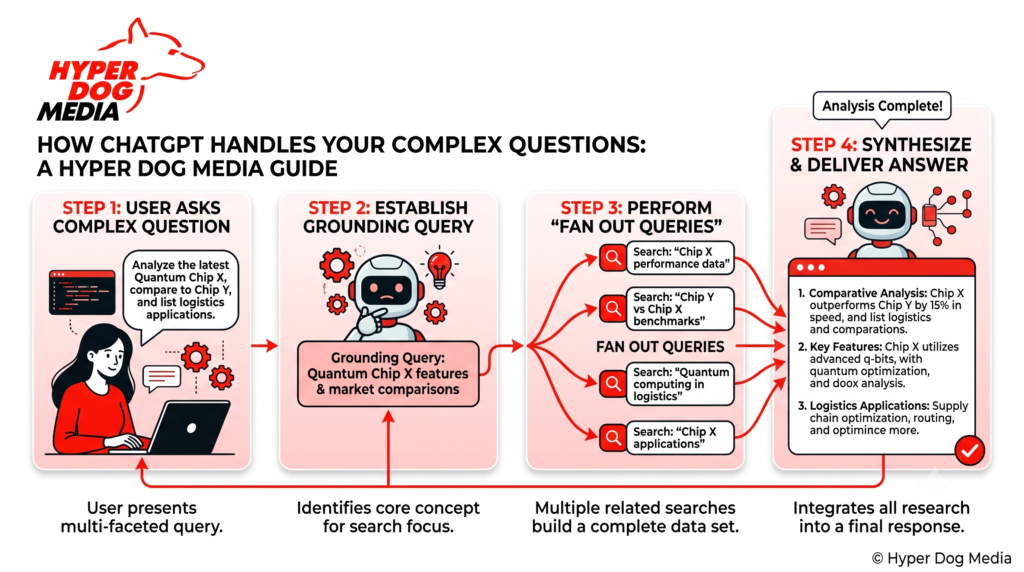
That’s not what happens with AI search. When you ask ChatGPT, Gemini, Perplexity, or Copilot a question, the model quietly turns your single prompt into it’s own little research project:
– It figures out the main topic, which is known as the Grounding Query. For example, it might be running shoes.
– The LLM and then performs a dozen or so separate searches around that Grounding Query. These are the “Fanout Queries” where context is adding in. An example might be “Best running shoes”. If the LLM knows you’re a beginner, it will probably have a Fanout Query about “Running shoes for beginners” or even “Best running shoes for beginners”.
Understanding them changes how you think about content, because the query you’re optimizing for is almost certainly not the query the AI is actually running.
Step 1: the model decides whether it needs to look anything up
An LLM has a huge amount of knowledge baked into its training data. For a lot of questions, that’s enough — nobody needs a live web search to learn what a keyword is.
But training data has a cutoff date, and it has gaps. So before answering, the model makes a judgment call: “am I confident enough to answer from my training data, or do I need outside evidence?” Queries about “latest,” “current,” or otherwise time-sensitive information tend to trigger web grounding, and some systems use an explicit confidence threshold — if the model’s internal knowledge scores below it, a search fires.
When the model decides it needs evidence, it forms a “grounding query”: the search it runs to anchor its answer to something real and verifiable. Grounding is the process of connecting AI output to verifiable, real-world information, and it’s the primary defense against hallucination — plausible-sounding statements that happen to be false.
That’s the “why.” The “how” is where it gets interesting for anyone producing content.
Step 2: one question becomes many
The model doesn’t run your question verbatim. It decomposes it.
Query fan-out is a retrieval technique that breaks a single complex prompt into multiple distinct sub-queries. Rather than treating the input as one isolated search term, the AI expands the intent, generating a series of related questions to gather a complete picture, runs those searches in parallel, and combines what it finds into a single readable answer.
Say someone asks: “Who’s the best search engine optimization company in Denver for a small business?”
The model doesn’t search that string. It fans out into something closer to:
– search engine optimization companies Denver
– small business website cost Colorado
– Denver search engine optimization agency reviews
– WordPress vs Squarespace for small business
– what to look for in a search engine optimization agency
– Denver marketing agency pricing
Six searches minimum. Often many more. Query fan-out takes one question and quietly explodes it into dozens — sometimes hundreds — of smaller questions.
Step 3.: synthesis
Once the sub-queries come back, the system pulls the top results from each into its context window and gets to work. It weighs the retrieved content against quality signals — experience, expertise, authoritativeness, trustworthiness — then reasons across the pieces, comparing facts and connecting them into a single coherent response. Good answers often go a step further and preemptively address the follow-up questions the user hadn’t asked yet.
What comes out isn’t a list of links. It’s one answer, assembled from fragments of ten or twenty different pages, with a handful of citations attached.
Why this matters for your website
Here’s the uncomfortable part: The prompt is not the query. You can rank #1 in Google for “Denver search engine optimization” and still be invisible in AI answers, because the model never searched that phrase. It searched six other things.
That reframes the whole optimization problem:
Ranking for one broad term isn’t enough
Each sub-query is a separate doorway into the synthesis process. The more of them your content shows up for, the more chances you have of being pulled in as a source.
Content needs to be atomic and answerable
Fan-out decomposes queries into distinct sub-questions, each targeting one facet of your ideal customer’s intent. A single sprawling page that vaguely covers a topic competes poorly against pages that answer one specific question cleanly. Clear headings, direct answers near the top of a section, and self-contained passages all make content easier to extract.
Answer Questions Directly
With Google’s old formula rewarding engagement, many content writers would lead a reader on – with answers at the end of the article. And in worse cases, a cookie recipe would begin with a heartfelt story of how the recipe was handed down. For readers that just wanted the recipe, this could be excruciating. And it’s excruciating for bots too! They want the answers quickly – and may not even “parse” the entire page. So put your questions and answers at the top!
Cover the adjacent questions, too not just the obvious one
If someone asking about faucet repair might need tools, steps, or a plumber, the fan-out will search all three. The site that covers the surrounding territory gets cited more often than the one that covers only the headline term.
Citations aren’t traffic
This is worth saying plainly: getting cited in an AI answer does not automatically mean a visit. Some analyses have found pages racking up large numbers of citations for grounding queries while registering almost no corresponding search impressions — a signal that a meaningful share of retrieval activity is programmatic rather than human. If you’re measuring AI visibility, cross-reference it against server logs and analytics rather than treating citation counts as a traffic proxy.
The practical takeaway
Traditional SEO asks: “what does my customer type into a search box?”
The new AI SEO / (aka AEO/ GEO: Answer Engine Optimization / Generative engine optimization, respectively) asks a harder question: “What does an AI type into a search box on my customer’s behalf?”
The answer is almost always “more than you’d think, and maybephrased differently than you’d guess.” Take your top ten customer questions, write out the eight to twelve sub-queries you think a model would generate for each, and check whether you have content that could plausibly satisfy them. The gaps in that list are your roadmap. Time to get to work answering your prospects’ questions!
The exact sub-queries any given platform generates aren’t public, and implementations differ between Gemini, ChatGPT, Copilot, and Perplexity. But the underlying behavior is consistent across all of them: the original query is treated as a starting point, not a final instruction. It’s very rare now that a prompt can be answered without the LLM performing a web search.
Build for the fan-out, not the phrase
Want help auditing how your site shows up in AI search? Contact Hyper Dog Media — we’ll map the query fan-out for your core services and show you where the gaps are.